
Wissen · Science · English
What If Earth Had Rings? Science Explained
By Torsten Weiß (DIGILISATOR) · Published 16 October 2026
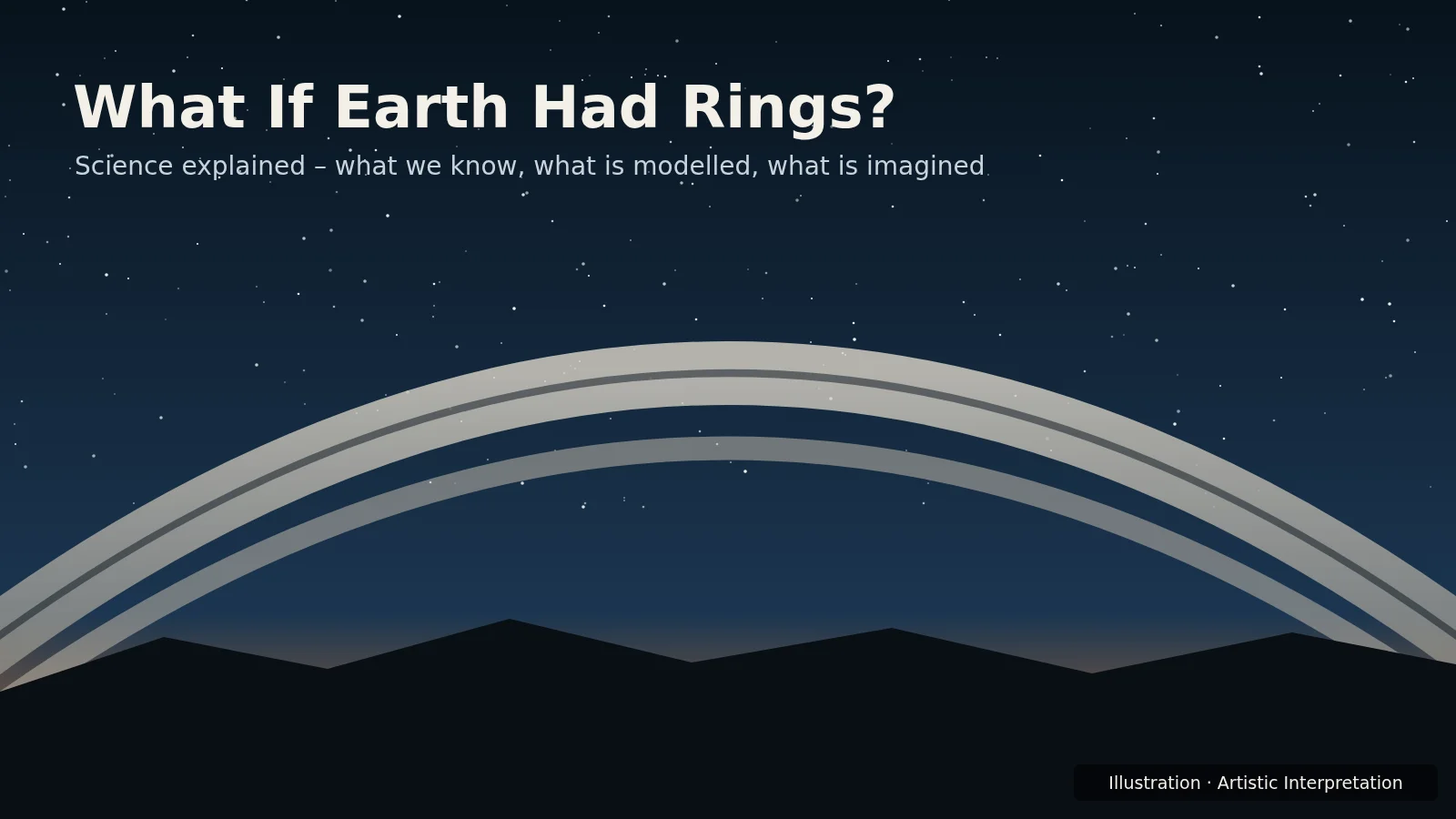
Short answer: A ring around Earth would most likely be a band of grey rock and dust circling above the equator. It would cast moving shadows across one hemisphere at a time and could cool parts of the planet. Whether Earth ever had such a ring is an open question. A 2024 study proposes that it did, about 466 million years ago, but that is a hypothesis, not a confirmed fact.
This DIGILISATOR guide answers the question step by step. Every statement carries one of exactly four labels, so you always know what kind of claim you are reading:
- [Established Science] – measured or widely accepted facts, with a source.
- [Model / Estimate] – results of calculations, simulations or geometric reasoning that depend on assumptions. Where the model is our own qualitative reasoning, we say so.
- [Scientific Hypothesis] – a proposed explanation published by researchers that has not yet been confirmed.
- [Artistic Interpretation] – imagined scenes and illustrations that make the idea tangible but are not predictions.
1. What a planetary ring actually is
Saturn as the reference case
[Established Science] Saturn's rings are mostly chunks of water ice, ranging from microscopic dust grains to boulders several metres across (NASA). The ring system extends up to about 282,000 km from the planet, yet the main rings are typically only about 10 metres thick, and each ring orbits at a different speed (NASA Science: Saturn facts).
[Established Science] Saturn is not unique. All large planets in our Solar System have rings; Jupiter, Uranus and Neptune have much fainter ones (Tomkins et al. 2024, abstract; The Conversation).
So the mental picture of a "solid disk" is wrong. A ring is a huge swarm of separate particles, each one travelling on its own orbit like a tiny moon.
How rings form: the Roche limit
[Established Science] When a small body such as an asteroid passes close to a planet, gravity stretches it. Inside a distance called the Roche limit, these tidal forces can break it into many small pieces and a few larger ones. Over time the fragments spread out into a debris ring around the planet's equator (The Conversation, written by the study authors; Monash University).
The equator matters here. A ring settles into the planet's equatorial plane, and material that later falls out of the ring tends to land near the equator. Keep this in mind; it is the key to the 466-million-year story below.
Rings are temporary
[Model / Estimate] Even Saturn's rings are not permanent. NASA-led research measured "ring rain", icy particles drawn into Saturn along its magnetic field. From this alone, the rings would be gone in about 300 million years; adding material that the Cassini spacecraft saw falling into Saturn's equator, the estimate drops to less than 100 million years. The same work suggests the rings are unlikely to be older than 100 million years (NASA).
These are estimates based on assumptions about loss rates, which is why we label them as models, not as fixed dates.
2. Earth with Saturn rings? Why an Earth ring would look different
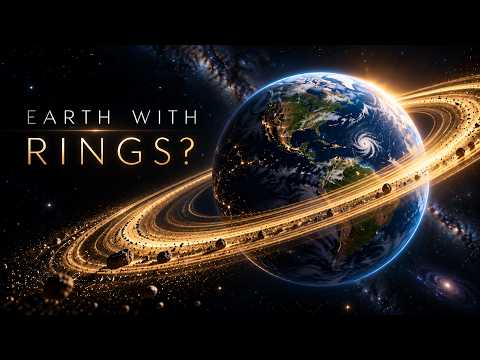
The popular image of "Earth with Saturn rings" usually shows bright, icy bands. That is the first thing a realistic scenario has to correct.
[Model / Estimate] If Earth gained a ring the way the 2024 study proposes, by tearing apart a passing asteroid, the ring would be made of rocky asteroid material, not water ice. The study links its proposed ring to fragments of the L chondrite parent body, a type of stony meteorite (Tomkins et al. 2024).
[Model / Estimate, our qualitative reasoning] Rock and dust reflect less sunlight than clean ice, so such a ring would probably look greyer and dimmer than Saturn's. How bright it would appear depends on particle size, density and width, none of which are known for a hypothetical ring.
What you would see from the ground
[Model / Estimate, our qualitative geometry] Because a ring lies in the plane of the equator, where you stand changes everything:
- At the equator: you would look at the ring exactly edge-on. With main rings only metres thick (in Saturn's case), it would appear as a thin line running straight overhead from east to west.
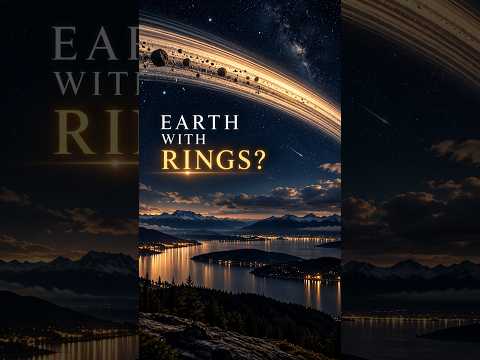
- At mid-latitudes, for example in Europe: the ring would rise as a broad arch across the southern sky (in the Northern Hemisphere), tilted and wider than from the equator.
- Near the poles: depending on how far the ring reaches from Earth, it might sit low on the horizon or not be visible at all, hidden behind the curve of the planet.
At night, parts of the ring outside Earth's shadow would still be lit by the Sun, so it could stay visible long after sunset. We do not give numbers for heights or angles here, because they depend on a ring size that nobody can specify.
3. How would Earth's rings affect climate?
This is where the question becomes more than a pretty picture.
Shadows and seasons
[Established Science] Earth's axis is tilted 23.4 degrees relative to its orbit, and this tilt causes the seasons (NASA Science: Earth facts).
[Model / Estimate, qualitative] A ring above the equator would share that tilt. As Earth orbits the Sun, the ring's shadow would therefore fall mainly on the winter hemisphere, shifting from north to south over the year. The study authors describe exactly this mechanism: because the axis is tilted, the ring would have shaded parts of Earth's surface, so less sunlight would reach the planet (The Conversation).
How to read the diagram: sunlight comes from the left. In December the Northern Hemisphere is tilted away from the Sun. The ring lies in the equatorial plane, so on the side facing the Sun it sits north of the equator and blocks part of the incoming light. Its shadow falls as a band on the northern, winter hemisphere. In June the geometry flips and the shadow moves to the Southern Hemisphere.
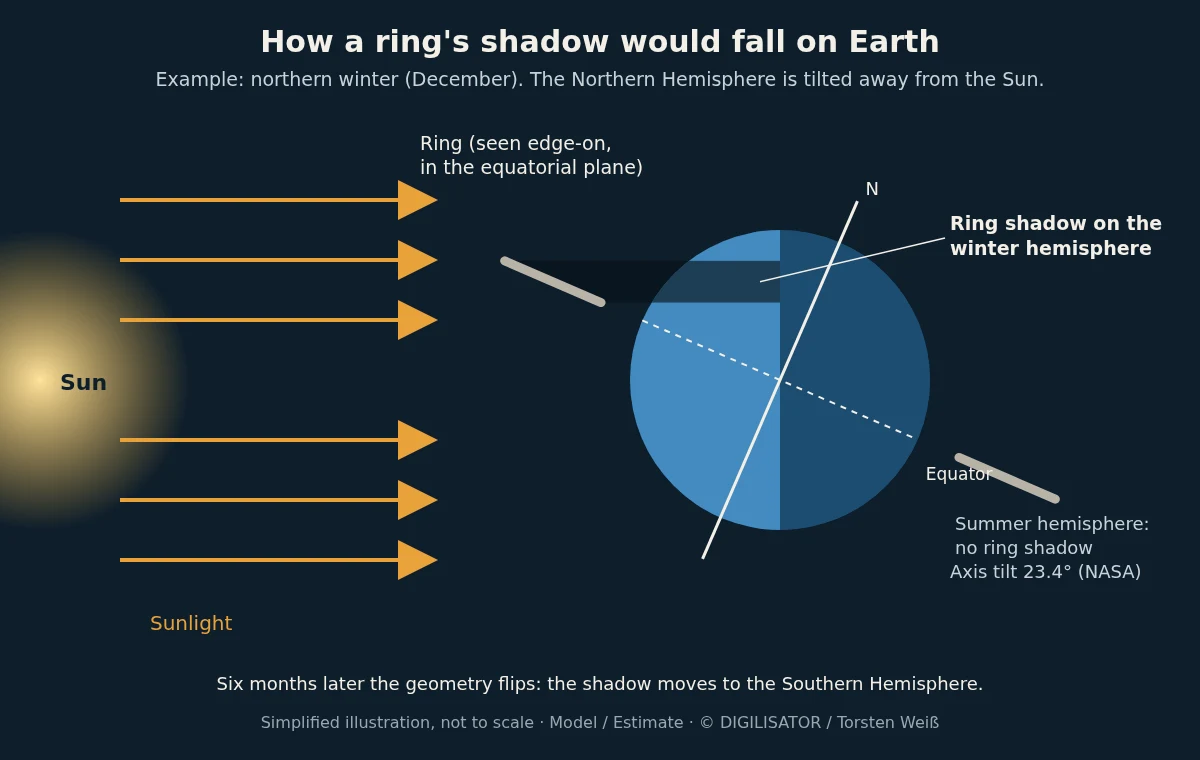
[Model / Estimate] Shading the hemisphere that is already in winter would intensify winter conditions there: less sunlight reaches the ground during the months when it is already scarce. It would not make winter last longer. The length of the astronomical seasons is set by Earth's orbit and axial tilt, and a ring does not change either.
What a climate model already shows
[Model / Estimate] The climate effect of an equatorial ring has in fact been simulated. Fawcett and Boslough (2002) ran an atmospheric general circulation model in which an orbiting equatorial debris ring was applied as a boundary condition (Fawcett & Boslough 2002, Journal of Geophysical Research: Atmospheres 107(D15), doi:10.1029/2001JD001230). According to their abstract:
- the primary effect is a severe cooling in the tropics and subtropics, especially under the seasonally migrating ring shadow;
- the globe cools and becomes drier, except monsoon regions, which become wetter;
- the Hadley cell weakens, giving drier tropics and weaker subtropical high-pressure cells in the winter hemisphere;
- because the tropics cool more than the mid-latitudes, the equator-to-pole temperature difference shrinks, leading to weaker winds and less storminess at high latitudes.
[Model / Estimate] The scenario is deliberately extreme. In section 1.3 of the paper, the authors assume a fully opaque ring (opacity 1) as an extreme test case. In section 5 they write that a real debris ring would probably not be completely opaque, so its effects would likely be less extreme than in the model (Fawcett & Boslough 2002).
Important limits: this is a model of a hypothetical ring, created by a large impact, not by the asteroid break-up proposed for 466 million years ago. The study was published in 2002, years before the Ordovician ring hypothesis, so it does not prove that Earth had a ring 466 million years ago, and it does not prove a link to the Hirnantian Ice Age. What it shows is that, in a climate model, a ring shadow is a powerful cooling mechanism, which makes the idea worth testing.
Was there a ring-driven ice age?
[Established Science] Around 465 million years ago, Earth began a period of strong cooling. By about 445 million years ago it was in the Hirnantian Ice Age, described as the coldest period in the past half a billion years (The Conversation; Monash University).
[Scientific Hypothesis] Tomkins and colleagues explicitly speculate that shading by a ring may have triggered this cooling (Tomkins et al. 2024). For their own scenario, they name the next steps: model how the asteroid broke up and how the ring evolved, then run climate models to test how much cooling that ring could cause (The Conversation). General ring-climate modelling exists (see above); a model of the specific Ordovician ring and its link to the ice age is still to come.
4. Did Earth once have rings? The 466-million-year hypothesis
What the study examined
The paper is: Tomkins, A. G., Martin, E. L. & Cawood, P. A. (2024). Evidence suggesting that earth had a ring in the Ordovician. Earth and Planetary Science Letters 646, 118991. doi:10.1016/j.epsl.2024.118991
[Established Science, findings reported in the paper] The authors looked at 21 asteroid impact craters from the Ordovician impact spike, an unusual period of about 40 million years with more meteorite impacts than normal. Using plate-tectonic reconstructions, they placed each crater where it was when it formed (Tomkins et al. 2024).
Their findings:
- All 21 craters lay within 30° of the equator at the time.
- Yet about 70 % of the exposed crust that could have preserved craters lay outside that band.
- The start of the period is marked by a large increase in L chondrite meteorite material in sedimentary rocks, dated to 465.76 ± 0.30 million years ago.
- Their binomial probability calculation gives P = 4 × 10⁻⁸ that this crater pattern came from asteroids arriving directly from the asteroid belt on ordinary orbits.
The Monash press release puts the probability in plain terms: it is like tossing a three-sided coin and getting tails 21 times in a row (Monash University).
What the authors propose
[Scientific Hypothesis] Their explanation: around 466 million years ago, a large fragment of the L chondrite parent body passed within Earth's Roche limit and broke apart. The debris formed a ring, and material falling out of that ring over millions of years produced the equatorial craters (Tomkins et al. 2024). In the authors' popular summary, the ring may have persisted for a few tens of millions of years (The Conversation).
The authors connect several other observations to the same event: limestone deposits in Europe, Russia and China with very high levels of meteorite debris, signs that this debris was exposed to space radiation for a shorter time than today's meteorites, and evidence of many tsunamis in that period (The Conversation).
Why this is not proof
It is worth being precise. The study does not find a ring. It finds a crater pattern that is hard to explain otherwise and proposes a ring as the explanation. The title itself says "evidence suggesting", and the highlights say Earth "may have had a ring" (Tomkins et al. 2024).
The main uncertainties, in DIGILISATOR's reading of the paper. They explain why the ring is classed as a [Scientific Hypothesis] rather than established science:
- Small sample. 21 craters is a meaningful number for a statistical test, but small in absolute terms. Each crater's age and position matter.
- Reconstruction dependence. Crater latitudes 466 million years ago come from plate-tectonic models. Different reconstructions could shift positions.
- Preservation bias. The authors try to account for where craters could survive, using only stable, suitably old crust (Monash University). Such corrections always rest on assumptions about erosion, burial and later tectonics.
- Alternative explanations. The probability value tests one specific alternative (impacts on ordinary orbits from the asteroid belt). It does not rule out every other possible explanation.
- Untested climate link. A general climate model of a ring shadow exists (Fawcett & Boslough 2002), but it assumes a fully opaque ring as an extreme case, and the link between this ring and the Hirnantian Ice Age has not been modelled yet.
None of this makes the idea weak. It makes it what it is: a serious, testable hypothesis published in a peer-reviewed journal, waiting for further work.
5. Life under a ringed sky
[Artistic Interpretation] These are thought experiments, not predictions:
- Calendars and navigation: a ring fixed to the equatorial plane would be a permanent reference line in the sky. Its arch and its shadow would change with the seasons, which earlier cultures could have used to track the year.
- Spaceflight: a debris ring would be a hazard zone. Satellites and launches would have to avoid it or cross it carefully.
- Light and night: a sunlit ring could brighten the night sky, which might affect animals that rely on darkness.
We include these points because they make the scenario tangible. They are imagination, not science.
More from DIGILISATOR (in German): how AI voices like the narration in many science videos are made – ElevenLabs: KI-Stimmen und Text-to-Speech; how AI agents fit into everyday life – KI-Agenten im Alltag; and if you enjoy thinking through puzzles step by step – CODEBREAKER – Rätselbuch für Erwachsene.
6. Reality Check: Established Science, Model / Estimate, Scientific Hypothesis, Artistic Interpretation
| Statement | Status | Source |
|---|---|---|
| Saturn's rings are mostly water ice, from dust to boulders several metres across | Established Science | NASA |
| Saturn's main rings are typically about 10 m thick, the system extends up to ~282,000 km | Established Science | NASA Science |
| Bodies inside the Roche limit can be torn apart and form an equatorial ring | Established Science | The Conversation |
| Saturn's rings may last less than 100 million more years | Model / Estimate | NASA |
| All 21 Ordovician impact-spike craters lay within 30° of the equator | Established Science (finding of the study) | Tomkins et al. 2024 |
| Earth had a debris ring from about 466 million years ago | Scientific Hypothesis | Tomkins et al. 2024 |
| An equatorial ring shadow cools the tropics and subtropics and weakens the Hadley cell (in a climate model with a fully opaque ring, an extreme case) | Model / Estimate | Fawcett & Boslough 2002 |
| A ring triggered the Hirnantian Ice Age | Scientific Hypothesis (speculation by the authors) | Tomkins et al. 2024 |
| An Earth ring would look grey and dim; its shadow would fall on the winter hemisphere | Model / Estimate (our qualitative reasoning) | this article |
| Life, calendars and night skies under a ringed sky | Artistic Interpretation | this article |
FAQ
What if Earth had rings like Saturn?
A realistic Earth ring would probably be made of rock and dust rather than ice, sit above the equator and cast shadows on the winter hemisphere. It would look like a thin line from the equator and a wide arch from mid-latitudes.
Did Earth once have rings?
Possibly. A 2024 study by Tomkins, Martin and Cawood proposes that Earth had a ring from about 466 million years ago. It is based on the equatorial pattern of 21 impact craters and is a hypothesis, not proof.
What happened 466 million years ago?
A period of unusually frequent meteorite impacts, the Ordovician impact spike, began then. Sedimentary rocks from that time contain large amounts of L chondrite meteorite material, dated to 465.76 ± 0.30 million years ago.
How would Earth's rings affect climate?
A ring would shade mainly the winter hemisphere and intensify winter conditions there, without making the season longer. A 2002 climate model (Fawcett & Boslough) found severe cooling in the tropics and subtropics, a weaker Hadley circulation and changed rainfall. The model deliberately assumed a fully opaque ring; the authors note that a real debris ring would probably not be fully opaque, so the effects would likely be less extreme. Whether a ring caused the Hirnantian Ice Age is still a hypothesis.
Why would an Earth ring not be icy like Saturn's?
In the proposed scenario the ring comes from a broken-up stony asteroid. Its material would be rock and dust, not water ice.
Watch: a calm science documentary on this question
If you prefer to explore the topic slowly, the full episode "What If Earth Had Rings Like Saturn? | A Calm Journey Under a Ringed Sky" walks through these ideas as a calm science documentary and ends with its own Reality Check. It is part of The Sky Rewritten, a YouTube channel that changes one physical condition of our world and follows the consequences. The Sky Rewritten is Torsten Weiß's own channel (DIGILISATOR). According to the video descriptions, the narration is AI-generated and some scenes are labelled AI-generated illustrations (Artistic Interpretation).
Sources
- Tomkins, A. G., Martin, E. L. & Cawood, P. A. (2024). Evidence suggesting that earth had a ring in the Ordovician. Earth and Planetary Science Letters 646, 118991. https://doi.org/10.1016/j.epsl.2024.118991
- Monash University (16 September 2024): Earth may have had a ring system 466 million years ago. https://www.monash.edu/science/news-events/news/2024/earth-may-have-had-a-ring-system-466-million-years-ago
- The Conversation (15 September 2024, written by one of the study authors): Hidden craters reveal Earth may once have had a ring – like Saturn. https://theconversation.com/hidden-craters-reveal-earth-may-once-have-had-a-ring-like-saturn-239068
- NASA: NASA Research Reveals Saturn is Losing Its Rings at "Worst-Case-Scenario" Rate. https://www.nasa.gov/news-release/nasa-research-reveals-saturn-is-losing-its-rings-at-worst-case-scenario-rate/
- NASA Science: Saturn facts. https://science.nasa.gov/saturn/facts/
- NASA Science: Earth facts. https://science.nasa.gov/earth/facts/
- Fawcett, P. J. & Boslough, M. B. E. (2002). Climatic effects of an impact-induced equatorial debris ring. Journal of Geophysical Research: Atmospheres 107(D15). https://doi.org/10.1029/2001JD001230